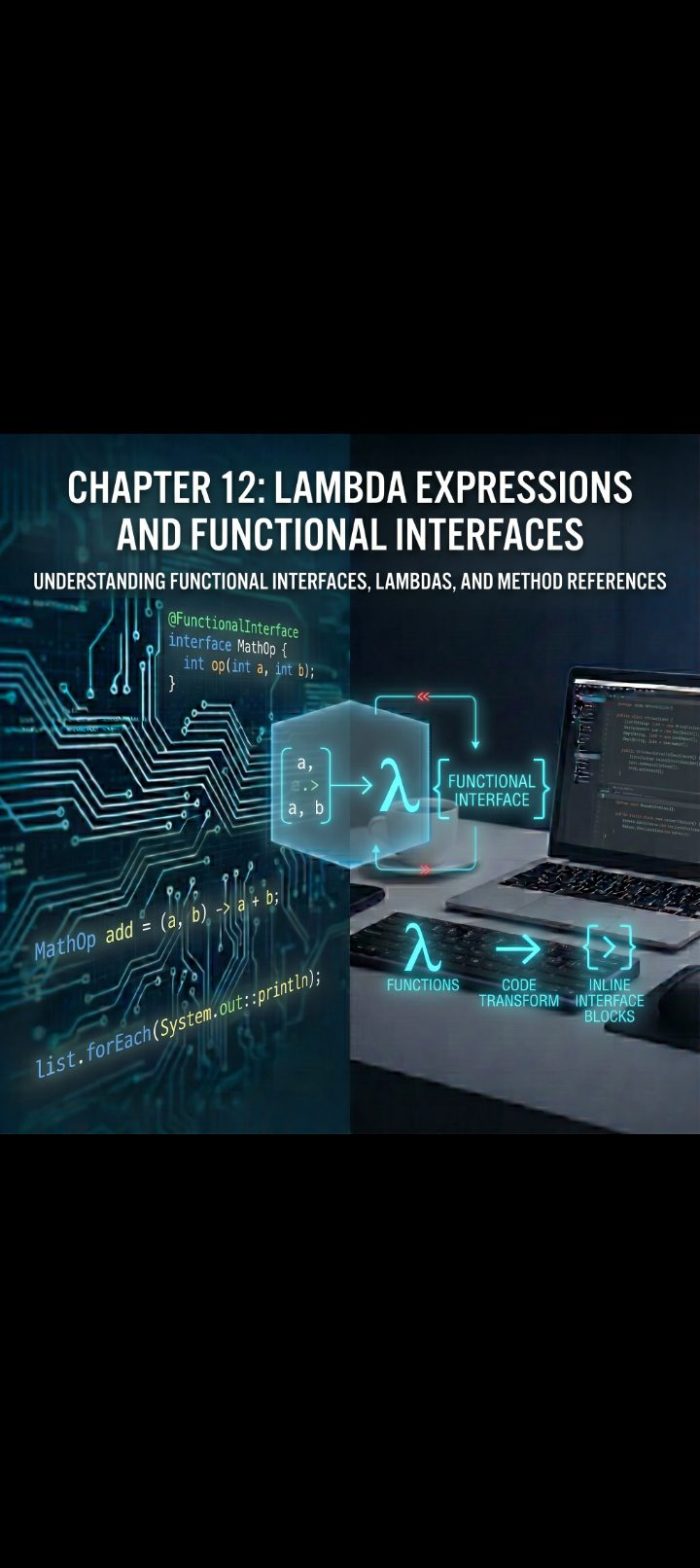
⚡ Chapter 12: Lambda Expressions and Functional Interfaces
## 1. The Problem: Boilerplate Before Lambdas
Suppose you have a list of strings and want to sort them by length rather than alphabetical order. Prior to Java 8, you had to pass an implementation of the `Comparator` interface using an **anonymous inner class**:
```java
List<String> names = Arrays.asList("Alexander", "Bo", "Catherine", "Dan");
// The pre-Java 8 ceremony
Collections.sort(names, new Comparator<String>() {
@Override
public int compare(String s1, String s2) {
return Integer.compare(s1.length(), s2.length());
}
});
```
Notice the ratio of ceremony to signal: out of six lines of code, only **one single expression** (`Integer.compare(s1.length(), s2.length())`) represents the actual business logic. The remaining five lines exist purely to satisfy Java's requirement that every method belong to a class instance.
With a lambda expression, that entire block shrinks to a single line:
```java
Collections.sort(names, (s1, s2) -> Integer.compare(s1.length(), s2.length()));
```
---
## 2. Anatomy and Syntax of a Lambda
A lambda expression is an **anonymous function**—a function without a name, return type, or access modifier that can be passed around like an object.
It consists of three parts:
```
(parameters) -> expression
or
(parameters) -> { statements; }
```
1. **Parameter List:** The input arguments matching the target method.
2. **Arrow Operator (`->`):** Separates arguments from the execution body.
3. **Body:** An expression (which automatically yields a return value) or a block enclosed in curly braces `{}`.
### Syntax Variations
```java
// 1. Zero parameters (parentheses required)
() -> System.out.println("Heartbeat pulse recorded");
// 2. Single parameter (parentheses are optional)
name -> System.out.println("Hello, " + name);
// 3. Multiple parameters with type inference (parentheses required)
(a, b) -> a + b;
// 4. Explicit parameter types (rarely necessary, but legal)
(int a, int b) -> a + b;
// 5. Multi-line body (requires curly braces and an explicit return keyword if returning a value)
(x, y) -> {
int sum = x + y;
int product = x * y;
return sum + product;
};
```
> **Type Inference Tip:** The Java compiler deduces parameter types automatically from context (the "target type"). Specifying `(String s1, String s2)` is almost always redundant; write `(s1, s2)` instead.
---
## 3. Functional Interfaces: The Foundation
A lambda cannot simply float in space; Java maps every lambda to a specific type. That type is always a **Functional Interface**.
A **Functional Interface** is an interface that contains **exactly one abstract method** (Single Abstract Method, or SAM). It may contain any number of `default` or `static` methods, but only one method awaits implementation.
### The `@FunctionalInterface` Annotation
While not mandatory, marking an interface with `@FunctionalInterface` instructs the compiler to enforce the SAM rule. If a second abstract method is added later, the compiler immediately halts with an error.
```java
@FunctionalInterface
public interface StringTransformer {
String transform(String input);
// Default methods do NOT count against the single abstract method rule
default void printInfo() {
System.out.println("Transforms a single string.");
}
}
```
You can now instantiate this interface directly with a lambda:
```java
public class LambdaAssignment {
public static void main(String[] args) {
// The lambda's signature (String) -> String matches StringTransformer's SAM
StringTransformer reverser = text -> new StringBuilder(text).reverse().toString();
System.out.println(reverser.transform("Framework")); // Output: krowemarF
}
}
```
---
## 4. The Built-in Functional Interfaces (`java.util.function`)
You rarely need to write custom functional interfaces. The standard library provides ready-made interfaces in the `java.util.function` package that cover nearly all practical use cases.
| Interface | Method Signature | Mental Model | Common Use Case |
| --- | --- | --- | --- |
| **`Predicate<T>`** | `boolean test(T t)` | **Evaluator** | Filtering, conditions, validations |
| **`Consumer<T>`** | `void accept(T t)` | **Sink / Processor** | Printing, logging, writing to disk |
| **`Function<T, R>`** | `R apply(T t)` | **Transformer** | Mapping, data conversion ($T \rightarrow R$) |
| **`Supplier<T>`** | `T get()` | **Factory / Source** | Lazy generation, providing defaults |
| **`UnaryOperator<T>`** | `T apply(T t)` | **Modifier** | Special `Function<T, T>` where in/out match |
| **`BinaryOperator<T>`** | `T apply(T t1, T t2)` | **Aggregator** | Math reducers, combining two identical types |
### Working Examples of the Core Four
```java
import java.util.function.*;
public class CoreFunctionalInterfaces {
public static void main(String[] args) {
// 1. Predicate: Accepts an argument, returns boolean
Predicate<Integer> isAdult = age -> age >= 18;
System.out.println("Can enter? " + isAdult.test(21)); // true
// 2. Consumer: Accepts an argument, returns void
Consumer<String> logger = msg -> System.out.println("[AUDIT LOG]: " + msg);
logger.accept("User root authenticated successfully");
// 3. Function: Accepts type T, returns transformed type R
Function<String, Integer> stringLengthCalculator = str -> str.length();
System.out.println("Length: " + stringLengthCalculator.apply("Microservice")); // 12
// 4. Supplier: Takes no arguments, returns a value
Supplier<Double> randomValueGenerator = () -> Math.random();
System.out.println("Random token: " + randomValueGenerator.get());
}
}
```
### Two-Argument Variants (The "Bi-" Family)
When dealing with two input variables:
* `BiPredicate<T, U>` $\rightarrow$ `boolean test(T t, U u)`
* `BiConsumer<T, U>` $\rightarrow$ `void accept(T t, U u)`
* `BiFunction<T, R U,>` $\rightarrow$ `R apply(T t, U u)`
```java
BiConsumer<String, Integer> scoreAnnouncer = (player, score) ->
System.out.println(player + " scored " + score + " points.");
scoreAnnouncer.accept("Marcus", 95);
```
---
## 5. Method References: Syntactic Sugar for Lambdas
When a lambda expression does nothing more than pass its parameters straight into an existing method, you can make it even cleaner using a **Method Reference** (`::`).
```java
// Standard Lambda
Consumer<String> printerLambda = s -> System.out.println(s);
// Method Reference Equivalent
Consumer<String> printerRef = System.out::println;
```
There are four distinct varieties of method references:
### 1. Static Method Reference (`ClassName::staticMethod`)
```java
// Lambda:
Function<String, Integer> parser1 = s -> Integer.parseInt(s);
// Method Reference:
Function<String, Integer> parser2 = Integer::parseInt;
```
### 2. Instance Method of an Arbitrary Object of a Specific Type (`ClassName::instanceMethod`)
```java
// Lambda:
Function<String, String> upper1 = s -> s.toUpperCase();
// Method Reference:
Function<String, String> upper2 = String::toUpperCase;
```
### 3. Instance Method of an Existing Object (`instance::instanceMethod`)
```java
String prefix = "PREFIX_";
// Lambda:
Function<String, String> tagger1 = str -> prefix.concat(str);
// Method Reference:
Function<String, String> tagger2 = prefix::concat;
```
### 4. Constructor Reference (`ClassName::new`)
```java
// Lambda:
Supplier<List<String>> listMaker1 = () -> new ArrayList<>();
// Constructor Reference:
Supplier<List<String>> listMaker2 = ArrayList::new;
```
---
## 6. Variable Scope: Variable Capture and "Effectively Final"
Lambdas can access variables declared outside their immediate body (in the enclosing method). This mechanism is called **variable capture**.
However, there is a strict rule: any local variable accessed inside a lambda must be **final** or **effectively final**.
* **Effectively Final:** A variable whose value is never modified after it is initialized, even if it lacks the explicit `final` keyword.
```java
public class ScopeDemo {
public void execute() {
int threshold = 50; // Effectively final
Predicate<Integer> tester = val -> val > threshold; // Legal: reads threshold
// threshold = 60;
// ERROR: Modifying threshold breaks effectively-final status.
// The lambda line above will now fail to compile!
}
}
```
### Why Does This Limitation Exist?
Local variables live on the **Stack**. If a lambda is passed to another thread, the enclosing method might complete and its stack frame might be destroyed while the lambda is still running.
To prevent memory corruption, the lambda creates a **copy** of that variable on the Heap. Allowing the variable to change would lead to desynchronization bugs between the local variable and the lambda's copied value.
---
## 7. Composing Functions
Functional interfaces in `java.util.function` include default methods that allow you to chain operations together like assembly lines.
### Chaining Predicates: `and()`, `or()`, `negate()`
```java
Predicate<String> startsWithJ = s -> s.startsWith("J");
Predicate<String> isLong = s -> s.length() > 5;
// Compound predicates
Predicate<String> startsWithJAndIsLong = startsWithJ.and(isLong);
Predicate<String> doesNotStartWithJ = startsWithJ.negate();
System.out.println(startsWithJAndIsLong.test("JavaScript")); // true
System.out.println(startsWithJAndIsLong.test("Java")); // false
```
### Chaining Functions: `andThen()` vs. `compose()`
* **`f1.andThen(f2)`:** Executes `f1` first, then passes the result to `f2`.
* **`f1.compose(f2)`:** Executes `f2` first, then passes the result to `f1`.
```java
Function<Integer, Integer> multiplyByTwo = x -> x * 2;
Function<Integer, Integer> addTen = x -> x + 10;
Function<Integer, Integer> mathPipeline = multiplyByTwo.andThen(addTen);
System.out.println(mathPipeline.apply(5)); // (5 * 2) + 10 = 20
```
---
## 8. Practical Example: A Dynamic Rule-Based Alert Engine
Let's apply lambdas and functional interfaces to build an extensible alerting system for server telemetry without writing rigid `if-else` blocks.
```java
import java.util.*;
import java.util.function.Consumer;
import java.util.function.Predicate;
class ServerMetric {
private final String hostname;
private final double cpuUsagePercent;
private final double memoryUsagePercent;
public ServerMetric(String hostname, double cpu, double memory) {
this.hostname = hostname;
this.cpuUsagePercent = cpu;
this.memoryUsagePercent = memory;
}
public String getHostname() { return hostname; }
public double getCpuUsagePercent() { return cpuUsagePercent; }
public double getMemoryUsagePercent() { return memoryUsagePercent; }
}
class AlertRule {
private final String ruleName;
private final Predicate<ServerMetric> condition;
private final Consumer<ServerMetric> action;
public AlertRule(String ruleName, Predicate<ServerMetric> condition, Consumer<ServerMetric> action) {
this.ruleName = ruleName;
this.condition = condition;
this.action = action;
}
public void evaluate(ServerMetric metric) {
if (condition.test(metric)) {
System.out.print("[TRIGGERED: " + ruleName + "] ");
action.accept(metric);
}
}
}
public class TelemetryMonitor {
public static void main(String[] args) {
List<AlertRule> rules = new ArrayList<>();
// Define rules declaratively using lambdas and method references
rules.add(new AlertRule(
"High CPU Load",
metric -> metric.getCpuUsagePercent() > 85.0,
m -> System.out.println("Alert Ops: " + m.getHostname() + " CPU at " + m.getCpuUsagePercent() + "%")
));
rules.add(new AlertRule(
"Critical Memory Depletion",
metric -> metric.getMemoryUsagePercent() > 95.0,
m -> System.out.println("Auto-scaling: Spawning node for " + m.getHostname())
));
// Incoming server states
List<ServerMetric> telemetryStream = Arrays.asList(
new ServerMetric("prod-app-01", 92.4, 60.1),
new ServerMetric("prod-db-01", 45.0, 97.8),
new ServerMetric("prod-web-01", 20.0, 30.0)
);
// Evaluate all rules across the telemetry batch
for (ServerMetric metric : telemetryStream) {
for (AlertRule rule : rules) {
rule.evaluate(metric);
}
}
}
}
```
---
## 📝 Chapter Summary
* **Lambda Expressions** provide a clear, concise syntax to express single-method implementations anonymously.
* A lambda can only be used where the expected type is a **Functional Interface** (an interface containing one single abstract method).
* The **`@FunctionalInterface`** annotation verifies at compile time that an interface satisfies the single abstract method contract.
* Standard interfaces in **`java.util.function`** cover most use cases:
* `Predicate<T>`: Evaluates conditions (`T -> boolean`).
* `Consumer<T>`: Consumes input without returning anything (`T -> void`).
* `Function<T, R>`: Transforms an input to an output (`T -> R`).
* `Supplier<T>`: Produces a value on demand (`() -> T`).
* **Method References (`::`)** simplify lambdas that merely forward arguments directly to an existing method.
* Captured local variables must remain **effectively final** to ensure thread safety and avoid stack corruption.
Lambdas make our code concise, but their real superpower appears when paired with collections. In the next chapter, we combine lambdas with pipelines to process data declaratively.