Chapter 13: C++ Encapsulation and Access Control—Protecting Data Integrity
By Ali Naqi | December 04, 2025
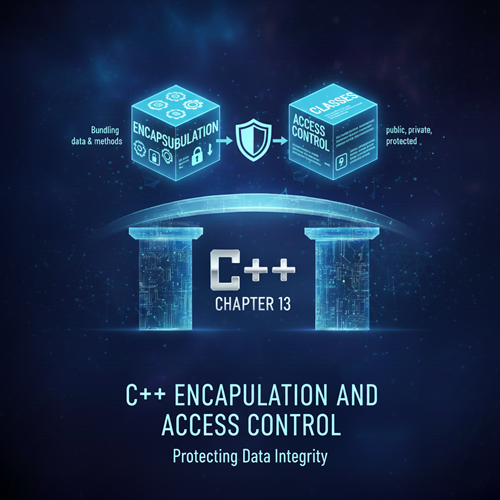
Chapter 13: Encapsulation and Access Control—Protecting Data Integrity
In the last chapter, you learned that a C++ class bundles data (variables) and behavior (methods) into a single unit. However, the Circle class we created had a flaw: its data member, radius, was marked public, meaning any part of the program could change it directly.
This chapter addresses the first and most fundamental pillar of Object-Oriented Programming (OOP): **Encapsulation**.
Section 1: The Principle of Encapsulation
**Encapsulation** means wrapping the data and the functions that operate on the data into a single unit (the class) and, crucially, **restricting direct access to some of the object's components**.
Think of a modern television. You can interact with it using a public interface (the power button, the volume controls). You cannot directly touch the internal circuits, microchips, or wiring. The internal workings are **private**. This prevents you from accidentally breaking the device and ensures that the manufacturer can change the internal components without affecting how you use the power button.
Access Specifiers: public and private
C++ uses **access specifiers** to enforce encapsulation rules. These specifiers are keywords that determine which parts of the program can access the members (data or methods) of a class.
-
public: Members declared here are accessible from anywhere in the program, including code outside the class. This forms the object's **external interface**. -
private: Members declared here are accessible **only** by methods and functions declared *within* the same class. They are hidden from the outside world. This is where you put the critical data that needs protection. -
(Note: We will discuss
protectedwhen we cover Inheritance in a later chapter.)
class BankAccount {
private:
    // Only methods inside BankAccount can access these directly
    double balance = 0.0;
    std::string accountNumber;

public:
    // Accessible from anywhere (the public interface)
    void deposit(double amount) {
        if (amount > 0) {
            balance += amount;
        }
    }
    // ... other public methods
};
If you tried to write myAccount.balance = 1000000.0; outside the class, the C++ compiler would generate an error because balance is private. This is the mechanism that enforces data protection.
Section 2: The Need for Protection—Data Invariants
Why is this necessary? To maintain **Data Invariants**. A data invariant is a rule or condition that must always be true for an object to be considered valid or correct.
For example, in a StudentGrade object:
- **Invariant:** The grade must be between 0 and 100.
- **Invariant:** The student ID must be a positive integer.
If external code can directly manipulate the data, it might violate an invariant (e.g., setting the grade to -50 or 150). By making the data private, we force all changes to go through controlled, public methods that can include **validation logic**.
Section 3: The Controlled Interface—Getters and Setters
Since the private data cannot be accessed directly, we must provide specific public methods to read or write those values under controlled conditions. These are known as **Accessor** and **Mutator** methods, or more commonly, **Getters** and **Setters**.
-
**Getters (Accessors):** Used to retrieve (get) the value of a private member.
- **Best Practice:** Getters should almost always be declared as
const, ensuring the method cannot modify the object's internal state.
- **Best Practice:** Getters should almost always be declared as
-
**Setters (Mutators):** Used to change (set) the value of a private member.
- **Key Feature:** Setters include validation logic to enforce data invariants before the change is applied.
Full Example: Encapsulated Grade
Let's enforce the rule that a grade must be between 0 and 100.
class Student {
private:
    std::string name;
    int grade; // The critical private data

public:
    // 1. Setter (Mutator) with Validation
    void setGrade(int newGrade) {
        if (newGrade >= 0 && newGrade <= 100) {
            grade = newGrade;
            std::cout << name << "'s grade set to: " << grade << std::endl;
        } else {
            // Rejects invalid input, protecting the invariant
            std::cerr << "Error: Grade " << newGrade << " is invalid." << std::endl;
        }
    }

    // 2. Getter (Accessor) - Note the 'const'
    int getGrade() const {
        return grade;
    }

    // A simple public method to initialize the name
    void setName(const std::string& studentName) {
        name = studentName;
    }
};

void demonstrate_encapsulation() {
    Student s1;
    s1.setName("Alice");

    // Valid change allowed via the setter
    s1.setGrade(95);

    // Invalid change rejected by the setter's validation logic
    s1.setGrade(110);

    // Reading the protected data via the getter
    std::cout << "Alice's Final Grade: " << s1.getGrade() << std::endl;

    // The following would cause a compiler error:
    // s1.grade = 500; // Error! 'grade' is private
}
Chapter 13 Conclusion and Next Steps
Encapsulation is not just about hiding complexity; it's about **designing reliable systems** where data integrity is guaranteed by the object itself. Always make your data members private and provide controlled public access through Getters and Setters. This is the standard of professional C++ development.
Now that you know how to define a class and protect its data, the next logical step is to learn how to properly bring an object into existence and clean it up when it's done.
In **Chapter 14**, we will study **Constructors and Destructors**, the special methods responsible for object initialization, resource management, and controlled destruction.